
Edexcel IAL Sample 2018 P4 (WMA14/01) Q7 Parametric Equations
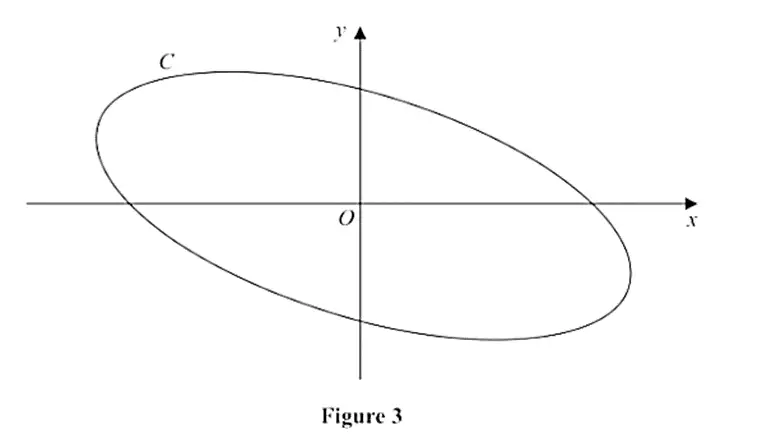
Figure 3 shows a sketch of the curve C with parametric equations
\( x = 4\cos\left(t + \frac{\pi}{6}\right) \qquad y = 2\sin t \qquad 0 \leq t \leq 2\pi \)
(a) Show that
\( x + y = 2\sqrt{3}\cos t \)(3)
(b) Show that a cartesian equation of C is
\( (x + y)^2 + 3y^2 = 12 \)
where a and b are integers to be found.(2)
\( x + y = 2\sqrt{3}\cos t \)(3)
(b) Show that a cartesian equation of C is
\( (x + y)^2 + 3y^2 = 12 \)
where a and b are integers to be found.(2)

Solution to Part (a): Proving using Trigonometric Identity
Key Concepts Used:
- Parametric Angle Addition Formula: Use cos(A + B) = cosAcosB – sinAsinB.
- Substitution: Replace known trigonometric values (cos\( \frac{\pi}{6} = \frac{\sqrt{3}}{2} \), sin\( \frac{\pi}{6} = \frac{1}{2} \)).
- Simplification: Combine terms to match the required expression.
Solution Steps
-
Expand x using angle addition:
Use the addition formula cos(A + B) = cosA cosB – sinA sinB, then substitute it to the equation.\( x = 4\cos\left(t + \frac{\pi}{6}\right) \)
\( x = 4\left(\cos t \cos \frac{\pi}{6} – \sin t \sin \frac{\pi}{6}\right) \)Where \( \sin \frac{\pi}{6} = \frac{1}{2} \) and \( \cos \frac{\pi}{6} = \frac{\sqrt{3}}{2} \).
\( x = 4\left(\cos t \times \frac{\sqrt{3}}{2} – \sin t \times \frac{1}{2}\right) \) -
Expanding the brackets and simplifying it.
\( x = 2\sqrt{3}\cos t – 2\sin t \)
Since \( y = 2\sin t \)
\( x = 2\sqrt{3}\cos t – y \)
\( x + y = 2\sqrt{3}\cos t \)
Final Answer:
\( x + y = 2\sqrt{3}\cos t \)
Solution to Part (b): Deriving the Cartesian Equation
Key Points
- Square Both Sides: Start from part (a) result to introduce cos²t.
- Trigonometric Identity: Use sin²t + cos²t = 1 to eliminate t.
- Substitution: Express cos²t in terms of y (y = 2sin t).
Solution Steps
-
Square x + y:
Square both sides to get cos²t term.\( (x + y)^2 = (2\sqrt{3}\cos t)^2 \)
\( (x + y)^2 = 12\cos^2 t \) -
Apply Trigonometric identity
Now, use the identity sin²t + cos²t = 1, together with y = 2sin t.\( (x + y)^2 = 12(1 – \sin^2 t) \)
\( (x + y)^2 = 12 – 12\sin^2 t \)
\( (x + y)^2 = 12 – 3y^2 \)
\( (x + y)^2 + 3y^2 = 12 \)
Final Answer:
\( (x + y)^2 + 3y^2 = 12 \)