
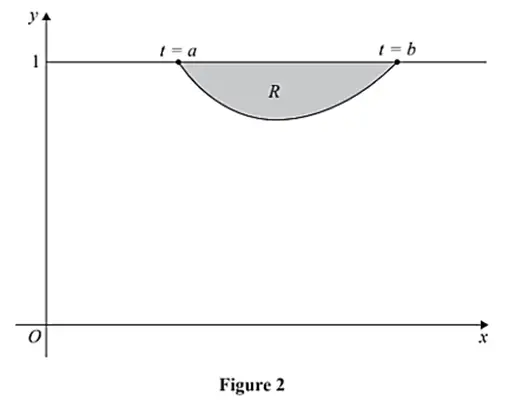
Figure 2 shows a sketch of the curve defined by the parametric equations
where a and b are constants.
The ends of the curve lie on the line with equation \( y = 1 \)
where M and k are constants to be found.(5)
- Write \( \frac{t+1}{t(3-t)} \) in partial fractions.
-
Use algebraic integration to find the exact area of R, giving your answer in simplest form.
(6)

- Implicit differentiation
- Normal line equation (negative reciprocal gradient)
-
Substitute the equation y = 1 in the parametric equation of curve of variable y.
\( y = \frac{2}{t(3-t)} \)
\( 1 = \frac{2}{t(3-t)} \)
\( t(3-t) = 2 \)
\( 3t – t^2 = 2 \)
\( 0 = t^2 – 3t + 2 \)
-
Solve the quadratic equation.
\( t^2 – 3t + 2 = 0 \)
\( t^2 – 2t – t + 2 = 0 \)
\( t(t-2) – 1(t-2) = 0 \)
\( (t-2)(t-1) = 0 \)
\( t = 1, \quad t = 2 \)
-
Hence, the value of a and b is
\( a = 1 \)
\( b = 2 \)
- Area Under Curve: Subtract the area under \( y \) from the rectangular area.
- Parametric Integration: Use Area = \( \int y \frac{dx}{dt} dt \).
-
Calculate x-values at endpoints:
\( x = t^2 + 2t \)
At \( t = 1 \):
\( x = 1^2 + 2(1) = 3 \)
At \( t = 2 \):
\( x = 2^2 + 2(2) = 8 \) -
Rectangular Area:
Consider the figure given in question.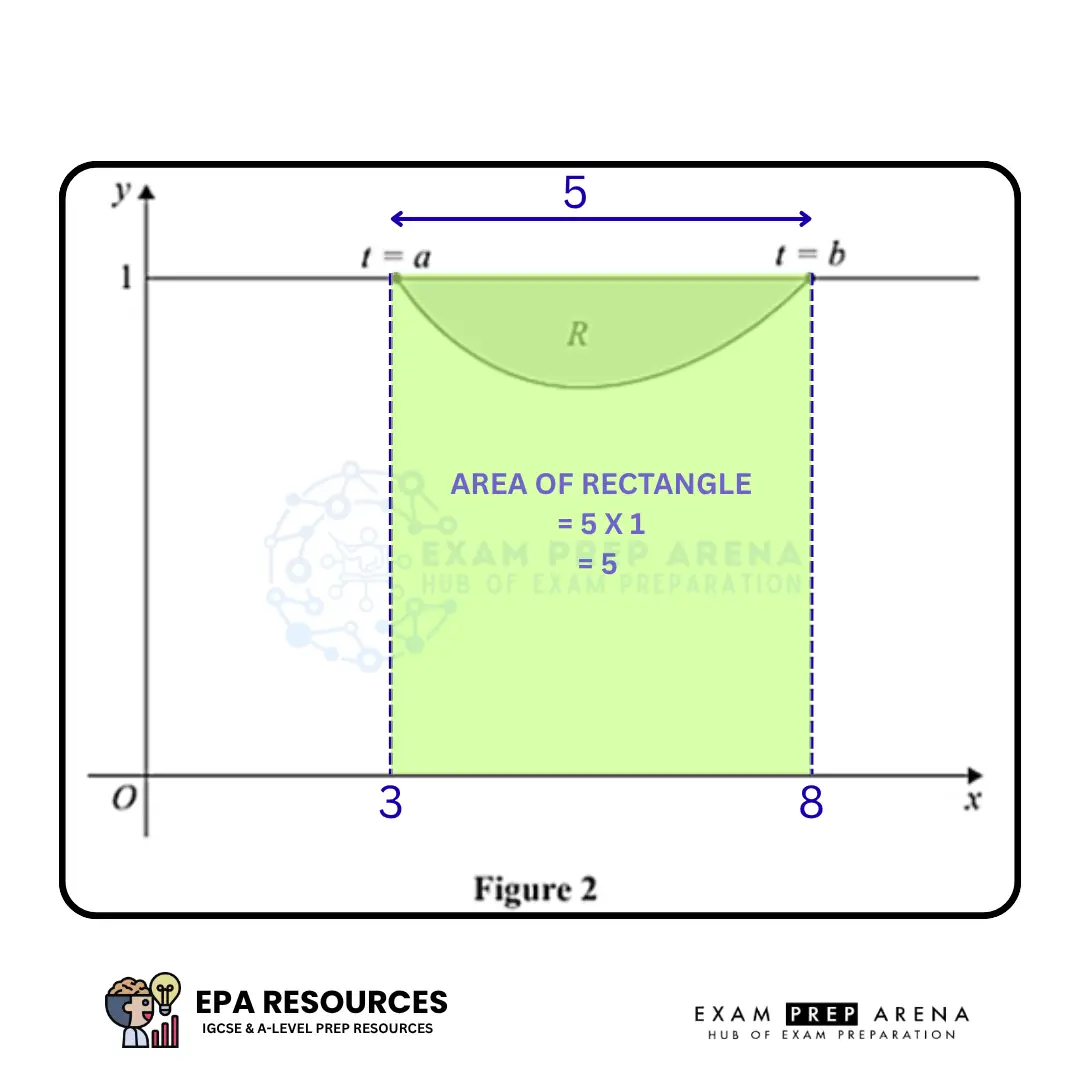
\( M = \text{Width} \times \text{Height} = (8-3) \times 1 = 5 \)
-
Integral Setup:
\( x = t^2 + 2t \)
\( \frac{dx}{dt} = 2t + 2 = 2(t+1) \)
\( dx = 2(t+1)dt \)Where the y-equation of curve
\( y = \frac{2}{t(3-t)} \)Let’s integrate the equation of curve to find the area enclosed between the curve and x-axis.Area under curve = \( \int_{1}^{2} \frac{2}{t(3-t)} \, dx \)
Substitute the value of dx from above in the equation.
Area under curve = \( \int_{1}^{2} \frac{2}{t(3-t)} \cdot 2(t+1) \, dt = 4 \int_{1}^{2} \frac{t+1}{t(3-t)} dt \)
-
Total Area \( R \):
\( \text{Area } R = \text{Area of rectangle} – \text{Area under area} \)
\( \text{Area of } R = M – 4 \int_{1}^{2} \frac{t+1}{t(3-t)} dt \)
\( \text{Area of } R = 5 – 4 \int_{1}^{2} \frac{t+1}{t(3-t)} dt \)
- Decomposition: Express as \( \frac{A}{t} + \frac{B}{3-t} \).
- Solve for \( A \) and \( B \): Use substitution.
-
Set Up:
\( \frac{t+1}{t(3-t)} = \frac{A}{t} + \frac{B}{3-t} \)
\( \frac{t+1}{t(3-t)} = \frac{A(3-t) + Bt}{t(3-t)} \)
Equating the numbers
\( t+1 = A(3-t) + Bt \) -
Solve for Constants:
-
Let \( t = 0 \):
\( 1 = 3A + 0 \)
\( A = \frac{1}{3} \)
- Let \( t = 3 \):
-
Let \( t = 0 \):
-
\( 4 = 0 + 3B \)
\( B = \frac{4}{3} \)\( \frac{t+1}{t(3-t)} = \frac{1}{3t} + \frac{4}{3(3-t)} \)
Final Answer:\( \frac{t+1}{t(3-t)} = \frac{1}{3t} + \frac{4}{3(3-t)} \)
- Integrate Partial Fractions: Use \( \int \frac{1}{t} dt = \ln|t| \).
- Combine Results: Substitute back into the area expression.
-
Integrate:
\( \text{Area of } R = 5 – 4 \int_{1}^{2} \frac{t+1}{t(3-t)} dt \)
\( \text{Area of } R = 5 – 4 \int_{1}^{2} \left( \frac{1}{3t} + \frac{4}{3(3-t)} \right) dt \)
\( \text{Area of } R = 5 – \frac{4}{3} \int_{1}^{2} \left( \frac{1}{t} + \frac{4}{3-t} \right) dt \)
\( \text{Area of } R = 5 – \frac{4}{3} \left[ \ln t – 4\ln(3-t) \right]_{1}^{2} \) -
Evaluate and Compute the Area R.
\( \text{Area of } R = 5 – \frac{4}{3} \left[ [\ln(2) – 4\ln(1)] – [\ln(1) – 4\ln(2)] \right] \)
\( \text{Area of } R = 5 – \frac{4}{3} (5\ln 2) \)
\( \text{Area of } R = 5 – \frac{20}{3} \ln 2 \)