

Edexcel IAL January 2021 P4 (WMA14/01) Q4 Parametric Equations – Domain and Range
The curve C is defined by the parametric equations
\( x = \frac{1}{t} + 2 \qquad y = \frac{1-2t}{3+t} \qquad t > 0 \)
(a) Show that the equation of C can be written in the form y = g(x) where g is the function
\( g(x) = \frac{ax + b}{cx + d} \qquad x > k \)
where a, b, c, d and k are integers to be found.(5)
(b) Hence, or otherwise, state the range of g.
(2)
(2)

Solution to Part (a): Forming Cartesian Equation
Key Concepts Used:
- Eliminating the Parameter (Express \( t \) in terms of \( x \) and substitute into the y-equation.)
- Algebraic Manipulation (Simplify the resulting expression to the required rational form.)
- Domain Consideration (Determine the minimum x-value (k) from the given t-range.)
Step-by-Step Working:
To form the cartesian equation, eliminate t from the equation.
The expression of function asked to be shown in the question is in terms of x and y or g(x). This means we need to form the cartesian equation of the curve by eliminating t from the equations.
-
Solve for \( t \) in the x-equation:
\( x = \frac{1}{t} + 2 \)
\( x – 2 = \frac{1}{t} \)
\( t = \frac{1}{x-2} \)
-
Now, substitute the value of \( t \) in the parametric equation of curve of y variable.
\( y = \frac{1-2t}{3+t} \)As \( y = g(x) \):
\( g(x) = \frac{1 – 2\left(\frac{1}{x-2}\right)}{3 + \frac{1}{x-2}} \) -
Simplify the expression
\( g(x) = \frac{1 – \frac{2}{x-2}}{3 + \frac{1}{x-2}} \)
\( g(x) = \frac{(x-2) – 2}{3(x-2) + 1} \)
\( g(x) = \frac{x-4}{3x-5} \)
For the value of \( k \), we have to first understand the range of \( x \) which is given in the question as \( t > 0 \).
\( x = \frac{1}{t} + 2 \)
Now, the range of x-t curve is \( x > 2 \) as at \( x = 2 \) there is an asymptote.
Therefore, the domain of the cartesian equation would be \( x > 2 \).
Final Answer:
\( g(x) = \frac{x-4}{3x-5} \)
\( a = 1,\, b = -4,\, c = 3,\, d = -5,\, k = 2 \)
Solution to Part (b): Finding the Range of y
Key Concepts Used:
As mentioned above, the range of the Cartesian function \( g(x) \) is represented by the output of the y parametric equation, given its restriction.
-
Identify the Parametric Equation for y and its Restriction
The curve C is defined by the parametric equation \( y = \frac{1-2t}{3+t} \), with the restriction that t is greater than zero (\( t > 0 \)). -
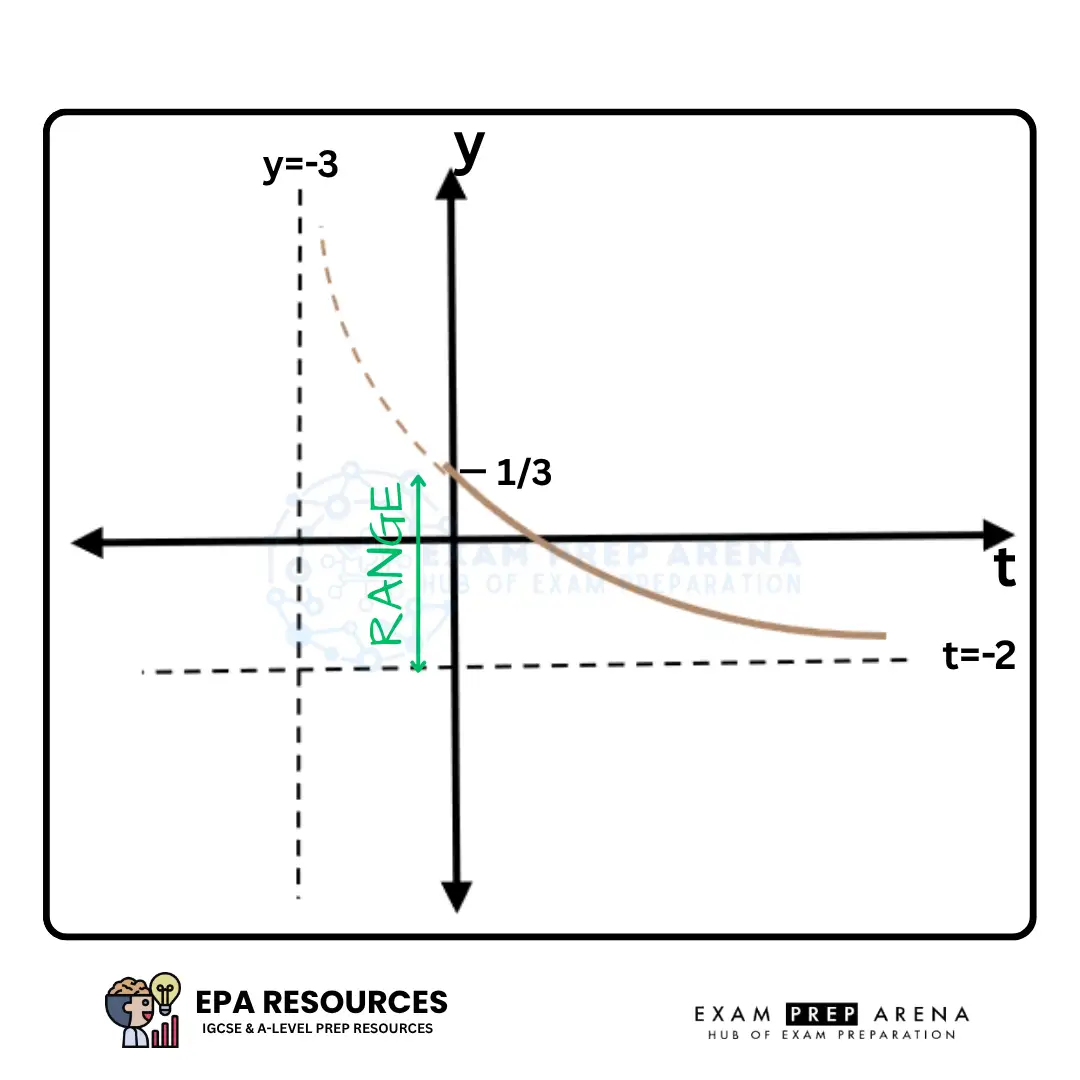
Determine Asymptotes of the y vs. t Graph
To understand the behavior of this reciprocal function, we identify its asymptotes:- Horizontal Asymptote: This is found by dividing the coefficients of t in the numerator and denominator. In \( y = \frac{-2t+1}{t+3} \), the coefficients of t are -2 and 1, respectively. Therefore, the horizontal asymptote is \( y = -2 \).
- Vertical Asymptote: This occurs where the denominator is zero. Setting \( 3 + t = 0 \) gives \( t = -3 \).
-
Sketch the Graph of y against t
- To determine the general shape of the graph (which quadrants relative to the asymptotes it occupies), we can find where it crosses an axis. Let’s find the Y-intercept by setting \( t = 0 \): \( y = \frac{1-2(0)}{3+0} = \frac{1}{3} \).
-
Since the graph crosses the y-axis at \( y = \frac{1}{3} \) (which is above the horizontal asymptote \( y = -2 \)), we know the graph must lie in the regions shown below, relative to its asymptotes:
- It will pass through \( (0, \frac{1}{3}) \).
- It will approach \( y = -2 \) as \( y \) approaches infinity.
- It will approach \( t = -3 \) as \( y \) approaches infinity.
- The two main branches of the reciprocal graph will be in the top-right and bottom-left sections formed by the asymptotes.
-
Apply the Condition \( t > 0 \): The crucial restriction is that t must be greater than zero. This means we only consider the part of the graph where t is positive.
- We discard all parts of the graph where t is zero or negative (to the left of the y-axis).
- The relevant part of the graph starts at the point where \( t = 0 \), which we found to be \( y = 1/3 \).
- As t increases from 0 (moving to the right on the t-axis), the graph for y will move downwards, approaching the horizontal asymptote \( y = -2 \) but never actually reaching it.
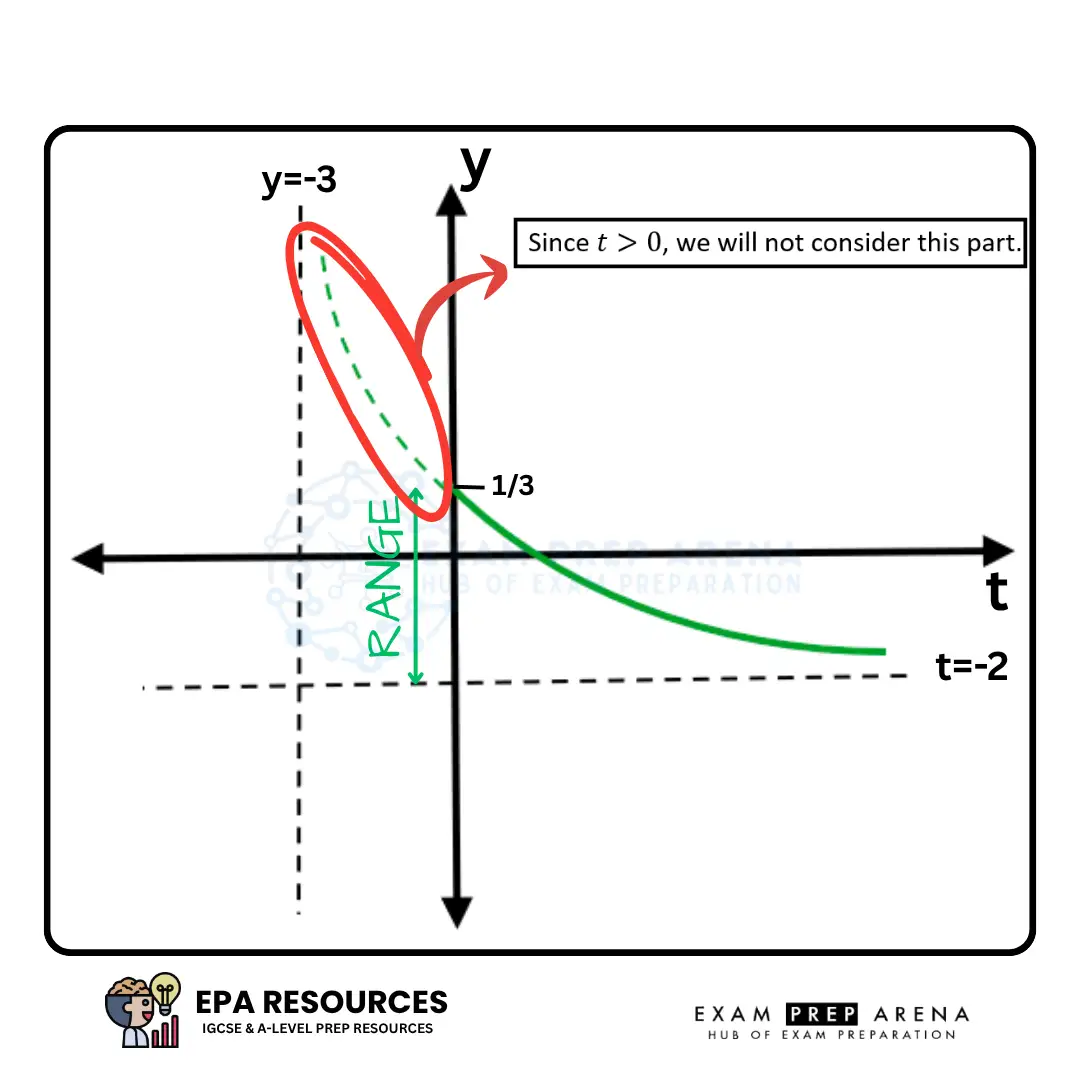
Hence. The range of \( g(x) \) is
\( -2 < g < \frac{1}{3} \)
Final Answer:
\( -2 < g < \frac{1}{3} \)