

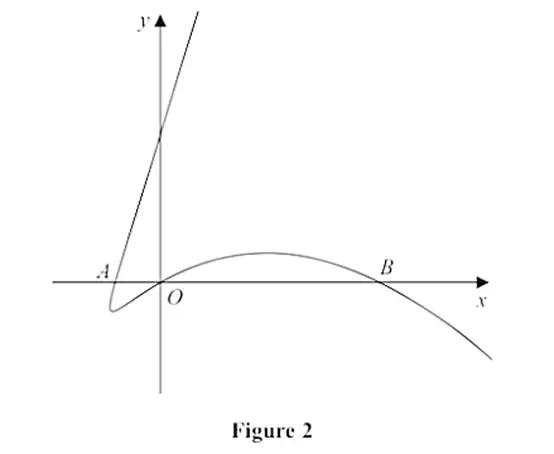
(a) Find the coordinates of A and B, where B has coordinates (20, 0).(3)
(b) Show that the equation of the tangent to the curve at B is
\( 7y + 4x – 80 = 0 \)(5)
The tangent to the curve at B cuts the curve again at the point P.
(c) Find, using algebra, the x coordinate of P.(4)

- Parametric equations: Solve for t when y = 0 (i.e. x-intercepts).
- Substitution: Find corresponding x values for each t
-
Step-by-Step Solution:
Find A and B:
Set \( y = 0 \):
Point A and B are points where the curve cuts the x-axis, meaning thereby \( y = 0 \).\( y = t^3 – 4t \)
\( 0 = t^3 – 4t \)
\( 0 = t(t^2 – 4) \)Use identity \( a^2 – b^2 = (a-b)(a+b) \).
\( t(t+2)(t-2) = 0 \)
\( t = 0 \quad t = -2 \quad t = 2 \) -
Find x-coordinates:
Substitute the values of t in parametric equation of x one by one.
For t = 0,\( x = 2t^2 – 6t = 2(0)^2 – 6(0) = 0 \)For t = -2,
\( x = 2t^2 – 6t = 2(-2)^2 – 6(-2) = 8 + 12 = 20 \)For t = 2,
\( x = 2t^2 – 6t = 2(2)^2 – 6(2) = 8 – 12 = -4 \)A (–4, 0)
B (20, 0)
- A: (–4, 0)
- B: (20, 0) (as required).
Most of the time students fall in trap in this question by doing the following two mistakes:
- Ignoring t = –2:
Students usually misses the negative parameter value; consequently, omitting point B. - Mislabeling order:
Moreover, at times I have I have observed that the students swap A and B. This happens when not considering the conventional left-to-right ordering.
- Parametric differentiation: \( \frac{dy}{dx} = \frac{dy/dt}{dx/dt} \)
- Point-slope form: \( y = m(x – x_1) + y_1 \)
We know that to form the equation of a tangent or any straight line, we need gradient and point that lies on the line.
-
Compute \( \frac{dy}{dx} \):
First, find the derivative of x and y w.r.t t.\( x = 2t^2 – 6t \)
\( \frac{dx}{dt} = 4t – 6 \)Where,
\( y = t^3 – 4t \)
\( \frac{dy}{dt} = 3t^2 – 4 \)Use chain rule to find dx/dx or the gradient of tangent.
\( \frac{dy}{dx} = \frac{dy}{dt} \times \frac{dt}{dx} \)
\( \frac{dy}{dx} = (3t^2 – 4) \times \frac{1}{4t – 6} \)
\( \frac{dy}{dx} = \frac{3t^2 – 4}{4t – 6} \)
So, the gradient at point B is found by substituting the value of t = –2.
(If you are wondering why we have taken the value of t as –2, check the working in previous part of finding the x coordinate of point B, we got x=20 when t is taken as –2.)
Now that we have gradient of tangent and coordinate of point B, use point-slope formula.
\( y – 0 = -\frac{4}{7}(x – 20) \)
\( 7y = -4x + 80 \)
\( 7y + 4x – 80 = 0 \)
- Substitution: Replace y from tangent equation into parametric y.
- Polynomial solving: Factorize \( 7t^3 + 8t^2 – 52t – 80 = 0 \).
We already found the tangent line at B (20,0) in part (b):
\( 7y + 4x – 80 = 0 \)
This tangent line intersects the curve again at another point P (besides B). We need to
find the x-coordinate of P algebraically (no graphic/calculator).
To find the point of intersection of curve and tangent (other than point B), solve both equations
simultaneously.
Equation of tangent:
-
Substitute \( y = -\frac{4}{7}x + \frac{80}{7} \) into \( y = t^3 – 4t \)
Substituting the parametric equations of curve in place of x and y (given in question).\( 7(t^3 – 4t) + 4(2t^2 – 6t) – 80 = 0 \)
\( 7t^3 – 28t + 8t^2 – 24t – 80 = 0 \)
\( 7t^3 + 8t^2 – 52t – 80 = 0 \) -
Factorize using \( t = -2 \) (known root) by applying long division method:
We know that \( t = -2 \) is a solution of the equation found above, so \( t+2 \) is a factor.\( 7t^3 + 8t^2 – 52t – 80 = (t+2)(7t^2 – 6t – 40) \)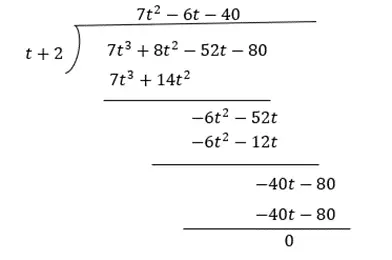
-
Solving the quadratic equation to find the value of t where the curve and tangent intersect.
\( 7t^2 – 6t – 40 = (t+2)(7t-20) = 0 \)
\( t = -2, \quad t = \frac{20}{7} \)Using \( t = 20/7 \) because \( t = -2 \) gives point B coordinate.
Hence, \( t = 20/7 \) gives\( x = 2t^2 – 6t = 2\left(\frac{20}{7}\right)^2 – 6\left(\frac{20}{7}\right) \)
\( x = 2 \times \frac{400}{49} – \frac{120}{7} \)
\( x = \frac{800}{49} – \frac{840}{49} \)
\( x = -\frac{40}{49} \)