
Mathematics at the Edexcel & Cambridge A-Level level is notoriously challenging, and many students struggle to achieve top grades. But why does this happen? Let’s dive deep and explore in the blog, an expert analysis by Sir Muhammad Abdullah Shah – .Founding Principal, Exam Prep Arena.
Every year, more than a million candidates appear the International A level Mathematics examination, collectively in Edexcel and Cambridge. Unfortunately, despite having access to online study materials, recommended books, and hard work, nearly 43% of candidates fail to get a grade higher than D. The weak grip on foundational mathematical skills and unawareness of exam techniques is the primary cause of the failure of many candidates. It all starts with a lack of comprehending the core concepts and practice of mathematics questions. For qualifying Edexcel IAL Maths examinations with flying colors, foundational mathematical skills, along with profound conceptual understanding of Calculus and mastery of Trigonometric Identities & problem solving becomes the determining element. Consequently, only a few cross over the main bridge and get a grade higher than C.
Nowadays, Mathematics has become one of the main subjects to get admission in the renowned global universities. Thousands of youngsters join the bandwagon each year, hoping to get into their dream universities. It does, however, need every ounce of effort. Unlike failure, your success is even cherished by the people who once called your journey “worthless and futile.” We often tend to focus on the strategies of successful people, but we fail to acknowledge that their success was somehow created by a failure they might have encountered during their success journey. Moreover, despite learning from heaps of books and notes, many A-Level students seem unsuccessful in identifying the reason behind the failure or their bad grades. There have been multiple reasons which have been haunting thousands for years.
A-Level mathematics is inherently difficult due to several core characteristics:
A-Level Maths builds directly and extensively on foundational concepts learned at (I)GCSE and IGCSE levels. Unlike other subjects where previous material might be revisited more thoroughly, A-Level Maths often assumes a strong grasp of earlier topics, with teachers potentially skipping initial recap chapters to move quickly into new content due to time constraints. To me, it is like building a giant skyscraper without paying importance to its foundation. Where (I)GCSEs are the foundations; if concepts like quadratic equations, algebraic fractions, or trigonometry (sine, cosine, tangent) are not fully understood from (I)GCSE, students will find the step up to A-Level very challenging. This concept is so fundamental that it’s compared to Isaac Newton’s famous quote, “Standing on the shoulders of giants,” implying that current work builds upon the achievements of those who came before.
A-Level Maths demands a high level of problem-solving skills, which many students may not have developed sufficiently during their GCSE or IGCSE studies. While GCSE questions are often shorter and broken down into subsections with more guidance, A-Level questions are significantly longer, carry more marks (up to 10 or 15), and provide much less structure and support. This requires students to not only know how to do the maths but also to independently determine the necessary steps to solve a problem. Some schools may not embed rigorous mathematical problem-solving or advanced thinking into their (I)GCSE teaching, focusing instead on drilling techniques for exam success, which can leave students unprepared for the demands of A-Level. A high GCSE grade (e.g., a 9 or an A*/A) does not automatically guarantee readiness, as some students may have achieved these grades through rote learning or last-minute drilling rather than deep understanding and problem-solving ability.
Moreover, A-Level Maths necessitates a considerably greater amount of independent study compared to (I)GCSE. Students are expected to spend much more time outside of class on homework, tackle longer exercises, and commit more dedication to mastering complex ideas. The subject requires significant perseverance to achieve top grades. If a student enjoys maths, has a solid GCSE or IGCSE background, and has engaged with maths challenges, they may find this independent study enjoyable. However, for those who struggle or lack motivation, the sheer volume and complexity of the material can make it seem impenetrable, leading to demotivation. The long summer break between (I)GCSE exams (May/June) and the start of A-Level in September can also compound this issue, as students may lose some of their previously acquired knowledge during this period if they don’t engage in some preparatory maths.

To achieve A*/A grades in A-Level Maths more than just regurgitating the textbook is necessary! It needs to be general, and be able to be applied outside the ones you know and are comfortable in thinking about. Below are listed few indispensable math skills for cumulative success at this high level:
This is the bread and butter of A-Level Maths. You need to be confident and correct in:
You must have a solid hand on trigonometric identities (including double angle and addition formulae).
A Level Maths (particularly in Pure Mathematics) also places a lot of emphasis on proof for mathematical statements. This skill is in building logically sound, step by step arguments out of definitions, axioms, and previous proven theorems. It requires precision in language and notation.
Around 30 percent of exam every year is composed of questions from graphical portion of curriculum. Therefore, understanding the relationship between equations and their graphs is a must skill that all candidates must develop over the period of practice. Moreover, all functional graphs of particular functions (polynomials, exponentials, logarithms, trigonometric, reciprocal) and transformations are amongst the requirement. Similarly, using graphs to solve equations, inequalities, and visualize solutions or relationships in problems is a helpful tool for students in their A level Maths exam.
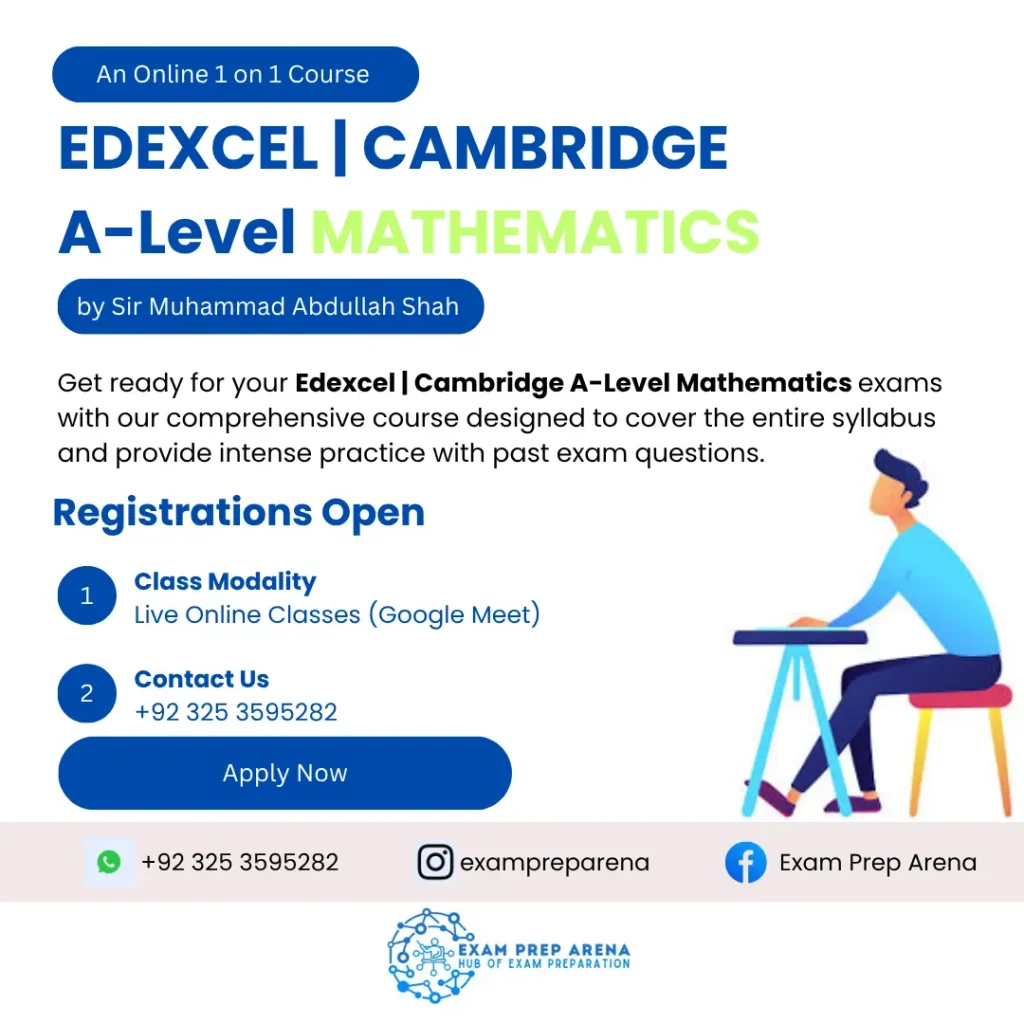
To conclude the discussion, Edexcel and Cambridge A level exam preparation demands 6 to 10 months of dedicated study. Therefore, no aspirant can prepare himself in just 1 to 2 months. Whoever gives his preparation serious thought and hard work for at least a year generally gets A grades. Many candidates ask me how your students get A* or OCLA in A level Mathematics exam, and we always tell them the same, “Remember, always be sincere to yourself whenever you start preparation because your parents, friends, and family attach hopes to you” Never let them down with haste because the competition has always been among hardworking students. You must compete with yourself, your nerves, and other competitive aspirants to have a place in the high achievers. And it can only be possible if you believe in yourself have faith in Almighty Allah, and prepare yourself thoroughly by yourself or by joining an expert and experienced teacher. Because in the end, it is always you who attempt the paper, and it is always your Almighty who helps you succeed.
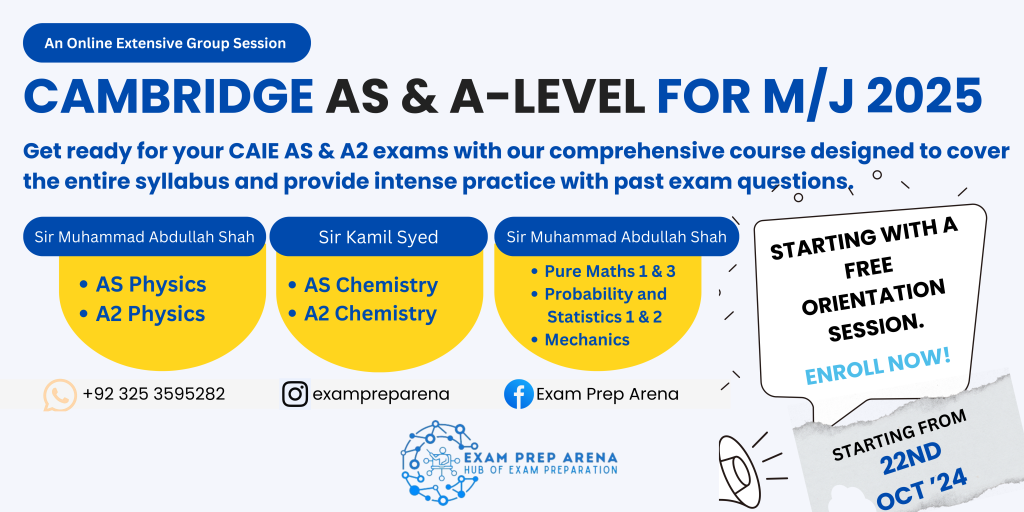
Let’s join to learn how to crack A-Level Maths, Physics, and Chemistry exam with proven strategies, comprehensive resources, and expert guidance.
Preparing for A-level Chemistry, Maths and Physics exams requires a well structured approach. Where the preparation depends on how rationally and conceptually a student covers the syllabus, the vigorous exam past papers practice matters significantly. Knowing all the versions and variants of the questions being asked by the examiner related to the topic is essential, and without it the preparation isn’t complete. Students believe that practicing questions from the book are enough for them to get a high score in any science subjects, which ultimately fails them badly in their respective exams. Contrarily to the very misconception propagated by some inept teachers and platforums, from the breakdown of the topic to the practice of the past exam questions at the end of every chapter is mandatory in A-Level’s journey irrespective of whatever the subject the student opt. Similarly , the practice of yearly past papers at the completion of the entire syllabus is pivotal for the student as it gives an opportunity to experience how real exam would look like; moreover, the yearly past paper practice helps the student in identifying any gaps in knowledge that need to be addressed before the exam. It is a fact, both topical and yearly past papers practice is core for scoring grade A* or A in the Cambridge International A-Level exams.
Exampreparena (EPA), under the supervision of Sir Muhammad Abdullah Shah & Sir Kamil Syed, has introduced an Online Extensive Course for A-Level Maths, Physics, and Chemistry for Edexcel IAL January 2025. This course is especially designed for the students who have planned to appear in January 2025 exams and wish to dive in deep to grip the concepts and comprehend the exam attempting technique, including the complete coverage of syllabus and vigorous practice of topical and yearly exam questions for the last 20 years. This course enables students to have hand on all the versions of the questions asked in the exam, focusing on the trend of the questions asked especially after the revision of syllabus in 2018.
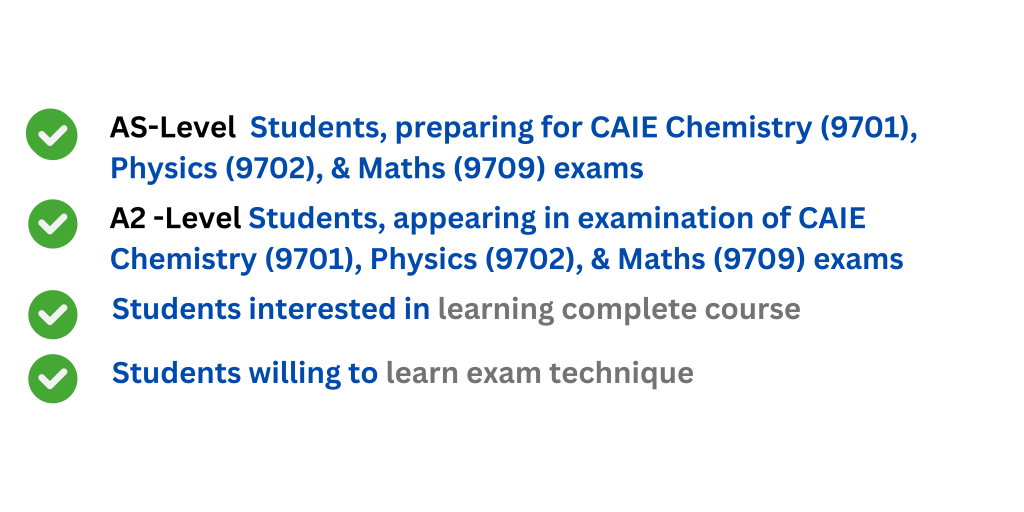
The Online Extensive Course for Cambridge International A-Level Maths, Physics, and Chemistry for May/June, 2025 starts from 22nd October, 2024. Whereas, the second batch would commence from the 1st week of December, 2024.
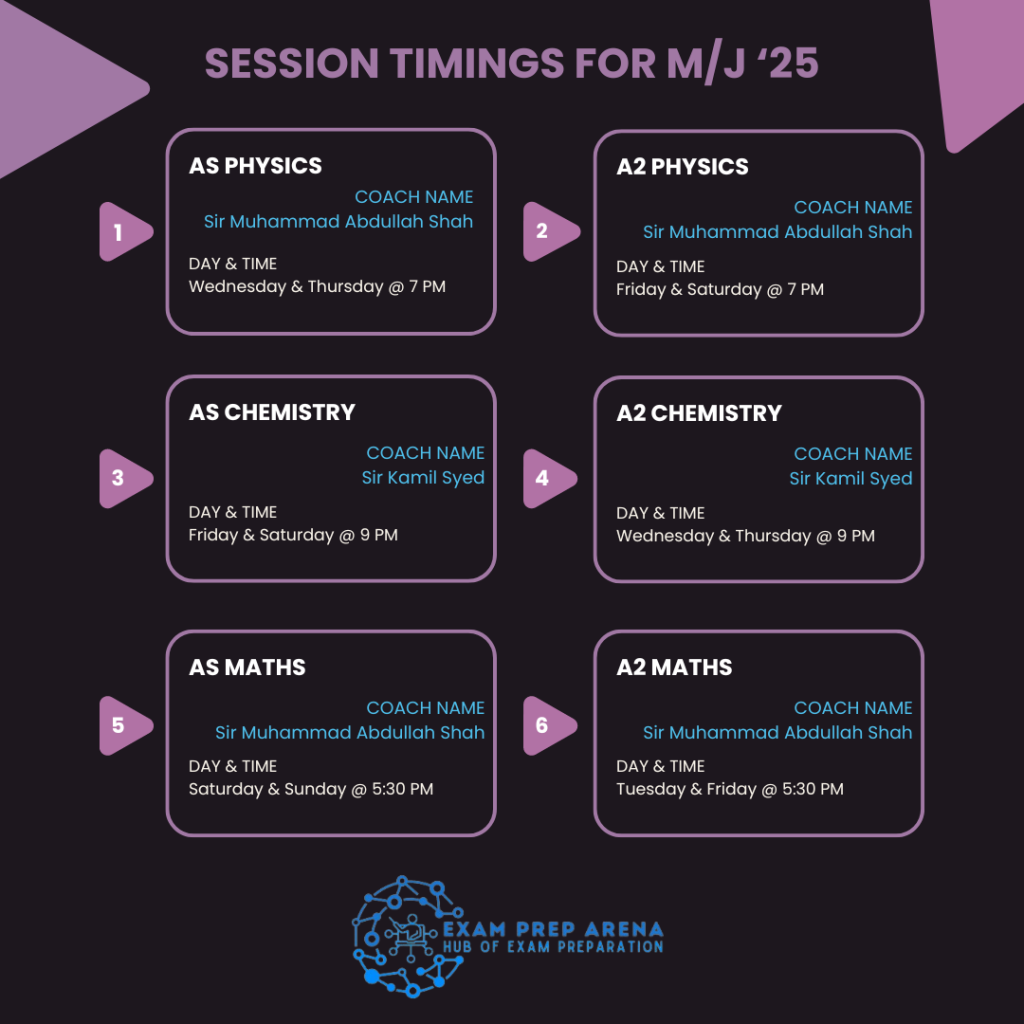
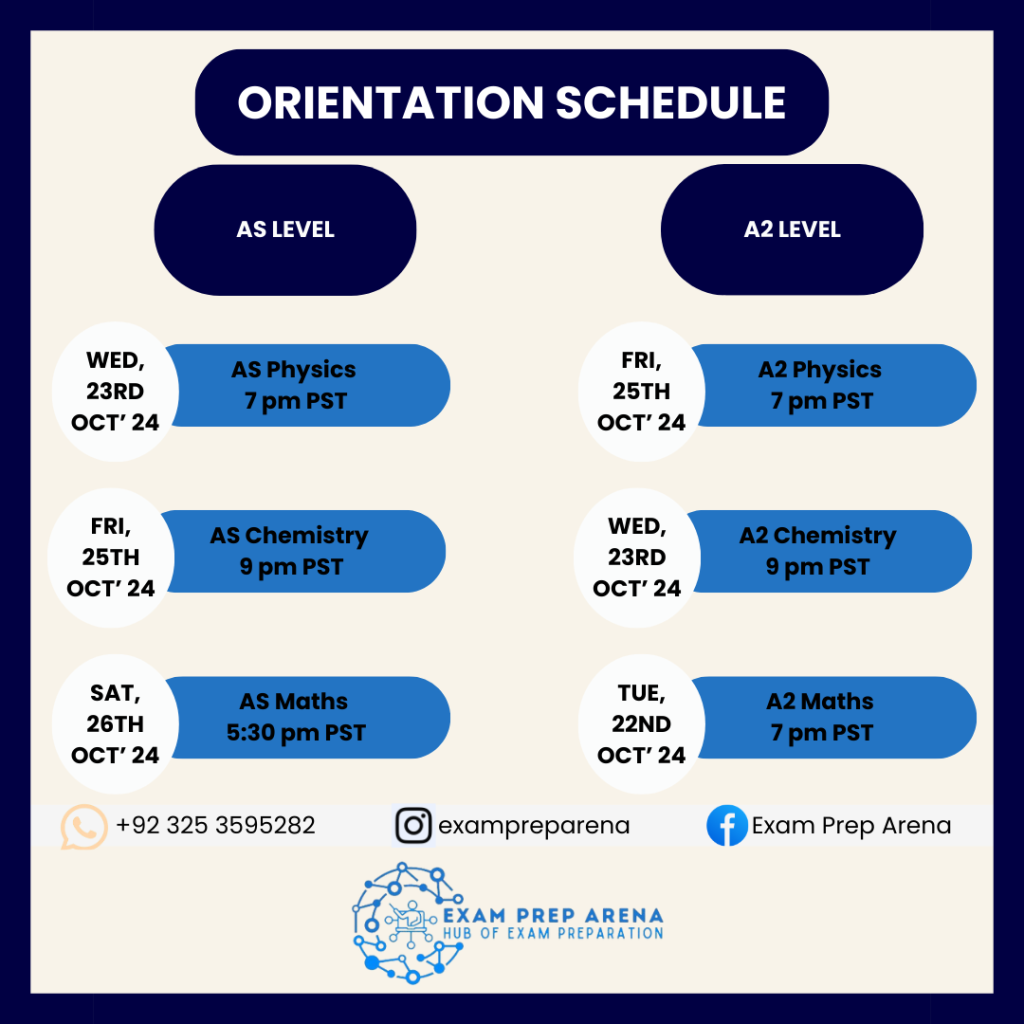
As a legacy of Exampreparena (EPA), the session would start with a free orientation session of all subjects and components taught in this course. Kindly contact the admin at +92 3253595282 for reserving your seat and getting access to further details of the orientation session.
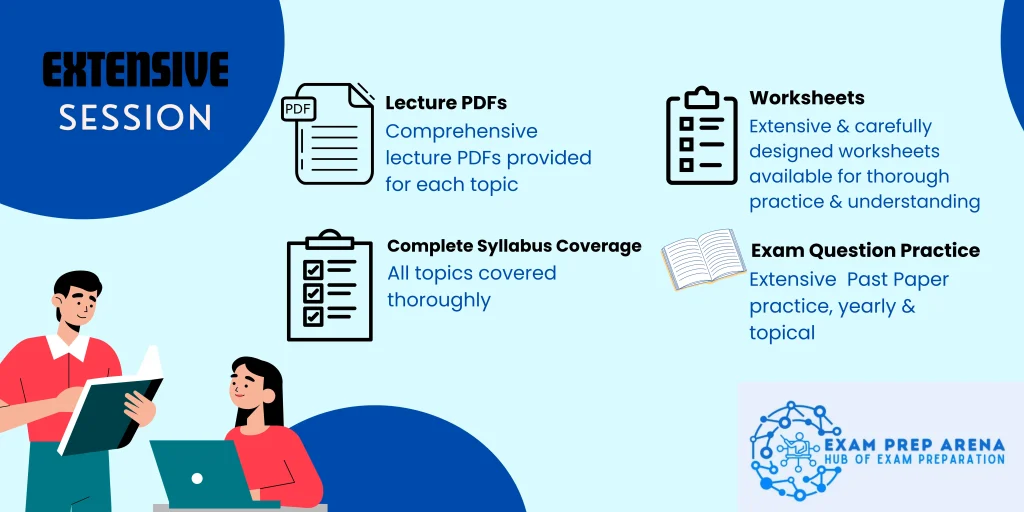
All the students enrolled in the extensive course will be provided with lecture PDFs, worksheets, & topical plus yearly past papers. The worksheets designed by each coach comprises of all variants of questions asked by the examiner in the last 25 years.
Secure your spot in the exclusive online session and pave your way to excellence. Contact us at +92 3253595282 to secure your place and embark on transformative learning experience or fill the form.

Let’s join to learn how to crack A-Level Maths, and Chemistry exam with proven strategies, comprehensive resources, and expert guidance.
Preparing for A-level Chemistry, Maths and Physics exams requires a well structured approach. Where the preparation depends on how rationally and coceptually a student covers the syllabus, the vigorous exam past papers practice matters significantly. Knowing all the versions and variants of the questions being asked by the examiner related to the topic is essential, and without it the preparation isn’t complete. Students believe that practicing questions from the book are enough for them to get a high score in any science subjects, which ultimately fails them badly in their respective exams. Contrarily to the very misconception propagated by some inept teachers and platforums, from the breakdown of the topic to the practice of the past exam questions at the end of every chapter is mandatory in A-Level’s journey irrespective of whatever the subject the student opt. Similarly , the practice of yearly past papers at the completion of the entire syllabus is pivotal for the student as it gives an opportiunity to experience how real exam would look like; moreover, the yearly past paper practice helps the student in identifying any gaps in knowledge that need to be addressed before the exam. It is a fact, both topical and yearly past papers practice is core for scoring grade A* or A in the Edexcel A-Level exams.
Exampreparena (EPA), under the supervision of Sir Muhammad Abdullah Shah & Sir Kamil Syed, has introduced an Online Extensive Course for A-Level Maths, Chemistry for AQA & Edexcel A-Level June 2025. This course is especially designed for the students who have planned to appear in June 2025 exams and wish to dive in deep to grip the concepts and comprehend the exam attempting technique, including the complete coverage of syllabus and vigorous practice of topical and yearly exam questions for the last 20 years. This course enables students to have hand on all the versions of the questions asked in the exam, focusing on the trend of the questions asked especially after the revision of syallbus in 2018.
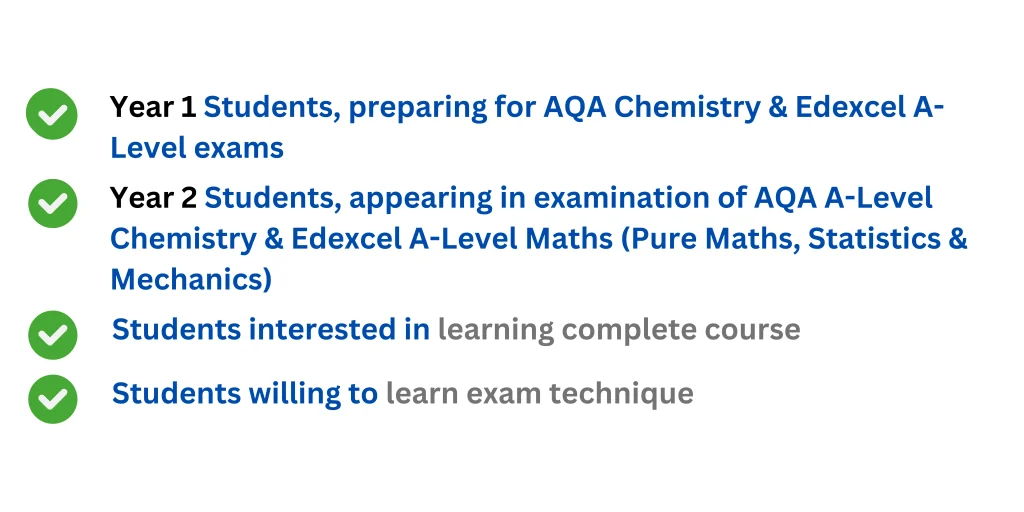
The Online Extensive Course for Edexcel International A-Level Maths, Physics, and Chemistry for January, 2025 starts from September. Whereas, the second batch would commence from November, 2024. And, similarly, the induction of new batches keeps on going by every 2 months. The student may join anytime across the academic year.
As a legacy of Exampreparena (EPA), the session would start with a free orientation session of all subjects and components taught in this course.

All the students enrolled in the extensive course will be provided with lecture PDFs, worksheets, & topical and yearly past papers.
Secure your spot in the exclusive online session and pave your way to excellence. Contact us at +92 3253595282 to secure your place and embark on transformative learning experience or fill the form.
Let’s join to learn how to crack A-Level Maths, Physics, and Chemistry exam with proven strategies, comprehensive resources, and expert guidance.
Preparing for A-level Chemistry, Maths and Physics exams requires a well structured approach. Where the preparation depends on how rationally and conceptually a student covers the syllabus, the vigorous exam past papers practice matters significantly. Knowing all the versions and variants of the questions being asked by the examiner related to the topic is essential, and without it the preparation isn’t complete. Students believe that practicing questions from the book are enough for them to get a high score in any science subjects, which ultimately fails them badly in their respective exams. Contrarily to the very misconception propagated by some inept teachers and platforums, from the breakdown of the topic to the practice of the past exam questions at the end of every chapter is mandatory in A-Level’s journey irrespective of whatever the subject the student opt. Similarly , the practice of yearly past papers at the completion of the entire syllabus is pivotal for the student as it gives an opportunity to experience how real exam would look like; moreover, the yearly past paper practice helps the student in identifying any gaps in knowledge that need to be addressed before the exam. It is a fact, both topical and yearly past papers practice is core for scoring grade A* or A in the Edexcel International A-Level exams.
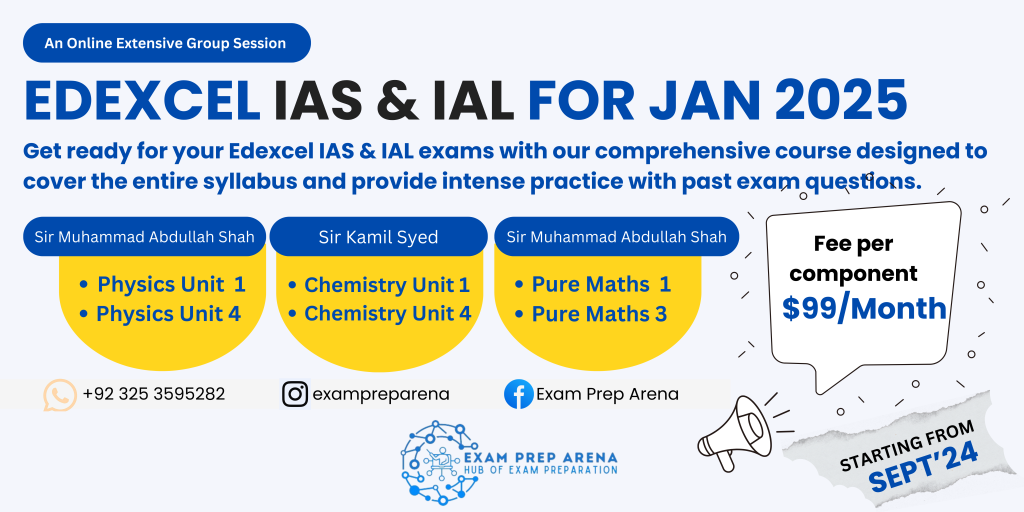
Exampreparena (EPA), under the supervision of Sir Muhammad Abdullah Shah & Sir Kamil Syed, has introduced an Online Extensive Course for A-Level Maths, Physics, and Chemistry for Edexcel IAL January 2025. This course is especially designed for the students who have planned to appear in January 2025 exams and wish to dive in deep to grip the concepts and comprehend the exam attempting technique, including the complete coverage of syllabus and vigorous practice of topical and yearly exam questions for the last 20 years. This course enables students to have hand on all the versions of the questions asked in the exam, focusing on the trend of the questions asked especially after the revision of syllabus in 2018.
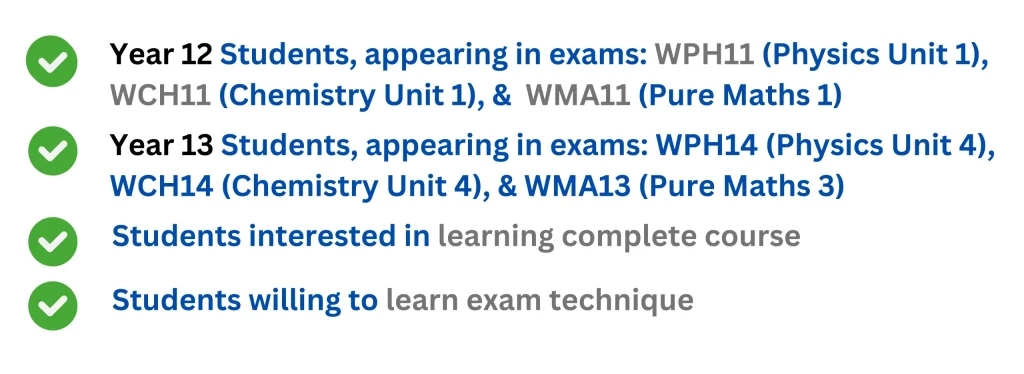
The Online Extensive Course for Edexcel International A-Level Maths, Physics, and Chemistry for January, 2025 starts from September. Whereas, the second batch would commence from October, 2024.

As a legacy of Exampreparena (EPA), the session would start with a free orientation session of all subjects and components taught in this course.
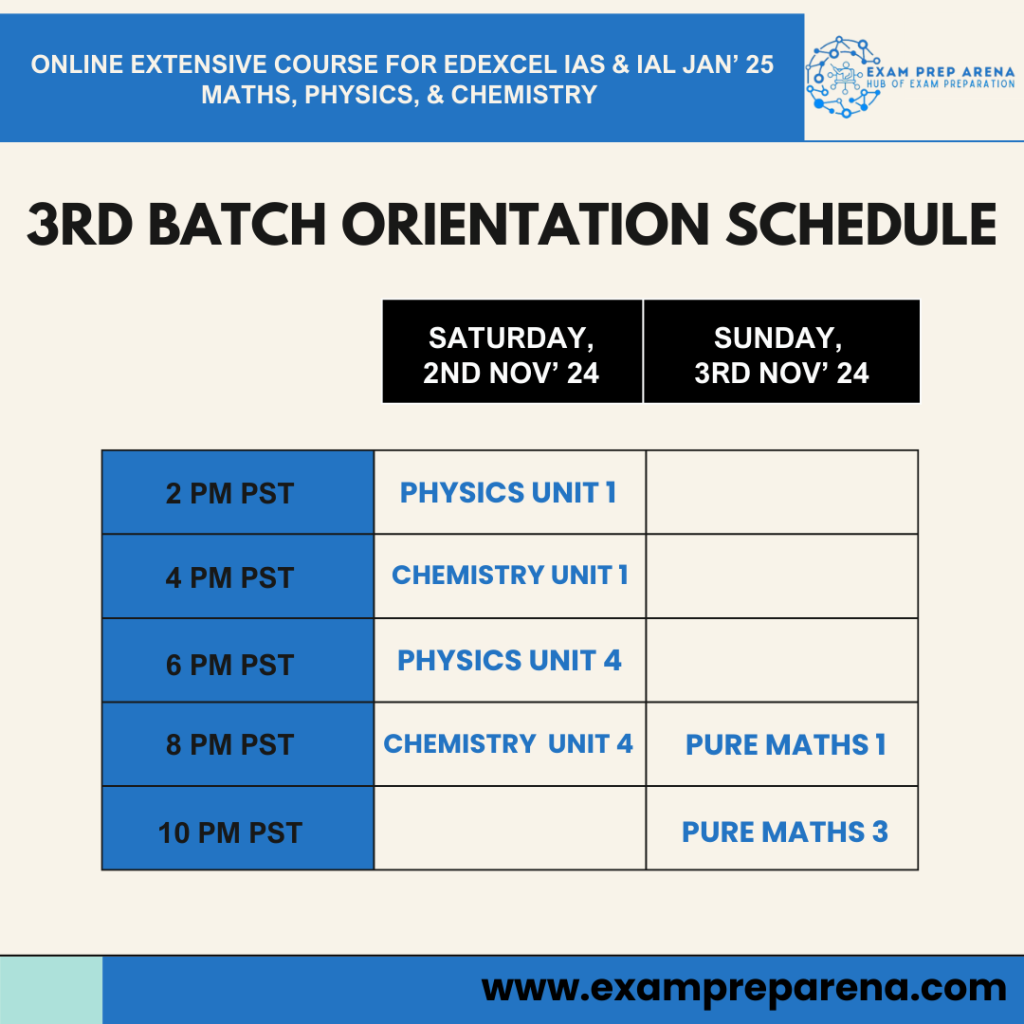
All the students enrolled in the extensive course will be provided with lecture PDFs, worksheets, & topical and yearly past papers.
Secure your spot in the exclusive online session and pave your way to excellence. Contact us at +92 3253595282 to secure your place and embark on transformative learning experience or fill the form.